
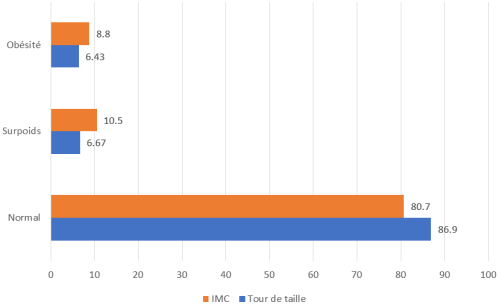
Overweight and obesity during adolescence are a global public health concern due to their potential impact on health and their increasing prevalence. The aim of this study is to determine the contribution of waist circumference and BMI in predicting obesity among adolescents attending public and private schools in Niamey (Niger). This is a descriptive cross-sectional study involving secondary school students aged 11 to 17. The survey is conducted from 1 April to 30 June 2021. For each student, weight, height and waist circumference were measured, and body mass index (BMI) and waist-to-height ratio were calculated. The 420 students enrolled, 193 were girls, giving a sex ratio (boys/girls) of 1.17. The average weight is 47.69±13.71kg. The average weight of girls is 49.66±13.57, ranging from 20 to 121kg. The average weight of boys is 46.01±13.62, ranging from 22 to 129.4kg. In girls, waist circumference increases between the ages of 12 and 15, from 60.90±12.93cm to 64.41±11.94cm, peaks at age 16 (67.38±9.58cm) and then decreases to 65.81±8.62cm at age 17. Among boys, the trend is also upward between the ages of 12 (58.63±5.63cm) and 17 (63.75±8.55cm). The waist-to-height ratio decreases between the ages of 12 and 17, with a rebound at age 16 for both girls and boys. In boys, the WHtR decreases from 0.44±0.00 at age 12 to 0.39±0.04 at age 15, rises to 0.41±0.05 at age 16 and then falls to 0.39±0.05 at age 17. The decrease in WHtR during adolescence is very significant (p=0.02). Girls are 2.35 times more likely to be overweight than boys (p=0.29). Overweight is a public health problem among adolescents in schools. It would be beneficial to integrate nutrition education into school curricula at an early stage. This could be an effective strategy with a long-term impact on reducing the prevalence of obesity and other non-communicable diseases in Niger.
| Published in | American Journal of Health Research (Volume 14, Issue 1) |
| DOI | 10.11648/j.ajhr.20261401.11 |
| Page(s) | 1-10 |
| Creative Commons |
This is an Open Access article, distributed under the terms of the Creative Commons Attribution 4.0 International License (http://creativecommons.org/licenses/by/4.0/), which permits unrestricted use, distribution and reproduction in any medium or format, provided the original work is properly cited. |
| Copyright |
Copyright © The Author(s), 2026. Published by Science Publishing Group |
Obesity, Overweight, BMI, Waist Circumference
Variables | Total (N = 420) | Gils (N=193) | Boys (N=227) | p-value |
|---|---|---|---|---|
Age (ans) | 14,84±1,49 | 14,79±1,42 | 14,87±1,54 | 0,590 |
Weight (kg) | 47,69±13,71 | 49,66±13,57 | 46,01 ±13,62 | 0,006 |
Waist (m) | 1,52±0,11 | 1,52 ± 0,91 | 1,52±0,13 | 0,944 |
BMI (kg/m2) | 20,26±4,59 | 21,20 ± 5,29 | 19,46±3,73 | 0,0001 |
WHtR (cm) | 63,96±11,77 | 64,87±10,01 | 62,42±9,08 | 0,0090 |
Tour de Taille / Taille | 0,41±0,05 | 0,41±0,06 | 0,40±0,05 | 0,005 |
Gender | Age (Ans) | %(N) | Weight (kg) | Waist (m) | BMI (kg/m2) | WHtR (cm) | WHtR/Waist |
|---|---|---|---|---|---|---|---|
Gils | 12 | 5,18(10) | 38,87±15,75a | 139±0,14a | 19,99±6,37a | 60,90±12,93a | 0,43±0,06a |
13 | 15,02(29) | 44,84±14,28ab | 149±0,08b | 19,98±5,04a | 63,83±9,87ab | 0,42±0,06a | |
14 | 23,32(45) | 48,55±11,67bc | 153±0,09bc | 20,72±4,11a | 63,93±8,51 ab | 0,41±0,05a | |
15 | 21,25(41) | 49,46±14,96bc | 154±0,08c | 20,70±6,77a | 64,41±11,94 ab | 0,41±0,08a | |
16 | 21,76(42) | 55,74±11,94c | 155±0,07c | 23,20±4,19a | 67,38±9,58b | 0,43±0,06a | |
17 | 13,47(26) | 51,67±11,18bc | 156±0,07c | 21,41±5,54a | 65,81±8,62 ab | 0,42±0,06a | |
p-value | -- | -- | 0,0001 | 0,0002 | 0,007 | 0,05 | 0,39 |
2 | -- | -- | 26,50 | 24,81 | 15,93 | 11,05 | 5,29 |
Moyenne | 14,79±1,42 | 100(193) | 49,66±13,57 | 1,52±0,91 | 21,20±5,29 | 64,87±10,01 | 0,41±0,06 |
Boys | 11 | 0,44(1) | 35,00±0,00 | 140±0,00 | 20,39±0,00 | 58,00 | 0,44±0,00 |
12 | 3,52(8) | 36,38±9,92a | 145±0,17a | 17,06±1,21a | 58,63±5,63a | 0,40±0,03a | |
13 | 21,15(48) | 34,54±6,26a | 139±0,10a | 17,72±2,16ab | 58,54±5,55 a | 0,42±0,04a | |
14 | 17,18(39) | 5,74±12,26b | 152±0,13b | 19,66±3,96bc | 63,67±10,77 ab | 0,41±0,06a | |
15 | 18,06(41) | 6,00±11,87b | 153±0,10b | 19,36±3,65bc | 60,41±7,82 a | 0,39±0,04a | |
16 | 19,82(45) | 3,95±16,81c | 160±0,11c | 20,91±4,92c | 66,75±10,56 b | 0,41±0,05a | |
17 | 19,82(45) | 52,52±9,19bc | 162±0,09c | 20,21±3,09c | 63,75±8,55 ab | 0,39±0,05a | |
p-value | -- | -- | 0,00 | 0,00 | 0,0001 | 0,000 | 0,02 |
2 | -- | -- | 88,20 | 90,74 | 29,20 | 39,25 | 14,99 |
Moyenne | 14,87±1,54 | 227 | 46,01±13,62 | 1,52±0,13 | 19,46±3,73 | 62,42±9,08 | 0,40±0,05 |
Total | 14,84±1,49 | 420 | 47,69±13,71 | 1,52±0,11 | 20,26±4,59 | 63,54±9,59 | 0,41±0,05 |
Gender | Normal | Abdominal Overweight | Abdominal Obesity | Total | p | 2 |
|---|---|---|---|---|---|---|
Girls | 80,31(155) | 11,40(22) | 8,29(16) | 100(193) | 0,004 | 10,99 |
Boys | 92,51(210) | 2,64(6) | 4,85(11) | 100(227) | ||
Total | 86,90(365) | 6,67(28) | 6,43(27) | 100(420) |
Genre | Normal | Visceral Overload | Total | p-value | 2 |
|---|---|---|---|---|---|
Girls | 87,56(169) | 12,44(24) | 100(193) | 0,29 | 1,11 |
Boys | 94,71(215) | 5,29(12) | 100(227) | ||
Total | 91,43(384) | 8,57(36) | 100(420) |
Variables | Boys | Girls | Total | p-value |
|---|---|---|---|---|
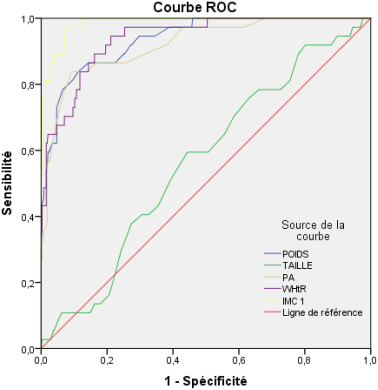
Weight | 0,944(0,877-1,00)* | 0,929(0,88-0,978)* | 0,937(0,899-0,974)* | 0,000 |
Waist | 0,709(0,592-0,826)* | 0,472(0,348-0,596) | 0,565(0,474-0,656) | 0,191 |
PA | 0,944(0,884-1,00)* | 0,907(0,839-0,975)* | 0,921(0,872-0,969)* | 0,000 |
WHtR | 0,902(0,819-0,984)* | 0,953(0,92-0,986)* | 0,939(0,904-0,973)* | 0,000 |
BMI | 0,993(0,984-1,00)* | 0,978(0,956-0,999)* | 0,986(0,976-0,997)* | 0,000 |
BMI | Body Mass Index |
CDC | Atlanta Centre for Disease Control and Prevention |
WC | Waist Circumference |
WHtR | Waist-to-height Ratio |
| [1] | Bonsaksen, T., Kottorp, A., Gay, C., Fagermoen, M. S., & Lerdal, A. Rasch analysis of the General Self-Efficacy Scale in a sample of persons with morbid obesity. Health and Quality of Life Outcomes, 2013; 11, 202. |
| [2] | Steiger, D., & Baumgartner Perren, S. “Poids corporel sain” chez les enfants et Adolescents. Actualisation des bases scientifiques. Berne et Lausanne: Promotion Santé Suisse Document de travail. 2014; 28. |
| [3] | Frelut LM. Childhood and adolescent obesity. Encycl Med Chir. 2009; 29(3): 1–15. |
| [4] | Tounian P. Adult-onset consequences of childhood obesity. Arch Pediatr. 200; 14(6): 718–720. |
| [5] |
WHO: World Health Organization. Obésité et surpoids. 2024.
https://www.who.int/fr/news-room/fact-sheets/detail/obesity-and-overweight |
| [6] | McCarthy HD, Jarrett KV, Crawley HF. The development of waist circumference percentiles in British children aged 5.0–16.9 y. Eur J Clin Nutr. 2001; 55(10): 902–7. |
| [7] | Savva SC, Tornaritis M, Savva ME, Kourides Y, Panagi A, Silikiotou N, et al. Waist circumference and waist-to-height ratio are better predictors of cardiovascular disease risk factors in children than body mass index. Int J Obes Relat Metab Disord. 2000; 24(11): 1453–8. |
| [8] | Weiss R, Dziura J, Burgert TS, Tamborlane WV, Taksali SE, Yeckel CW, et al. Obesity and the metabolic syndrome in children and adolescents. N Engl J Med. 2004; 350(23): 2362–74. |
| [9] | WHO. World health organization. Obesity: preventing and managing the global epidemic. Report of a WHO consultation. World Health Organization technical report series. 2000; 894: 1-253. |
| [10] |
WHO. Key indicators on obesity and overweight. 2020
https://www.who.int/fr/news-room/fact-sheets/detail/obesity-and-over |
| [11] | Goran MI. Visceral fat in prepubertal children: Influence of obesity, anthropometry, ethnicity, gender, diet, and growth. American Journal of Human Biology. 1999; 11(2): 201-207. |
| [12] |
WHO. World Health Organization. Global status report on no communicable diseases WHO: Geneva. Switzerland. 2010.
http://www.who.int/nmh/publications/ncd_report2010/en/ Consulté, le 25/07/2021. |
| [13] | Frühbeck G., Toplak H., Woodward E., Yumuk V., Maislos M., Oppert JM.. Executive Committee of the European Association for the Study of Obesity. Obesity: The Gateway to Ill Health - an EASO Position Statement on a Rising Public Health, Clinical and Scientific Challenge in Europe. Obesity Facts. 2013; 6: 117-120. |
| [14] | WHO. World Health Organization. Global status report on no communicable diseases. 2011. |
| [15] | Soumana A., Samaila A., Kamaye M., Sadaou A., Garba M., Mamoudou AD., Mahamane Sani MA., Sako Y. Surpoids et obésité en milieu scolaire urbain à Niamey (Niger). Revue de la Société Malgache de Pédiatrie, 2021; 4(2): 38-44. |
| [16] | Djadou KE, Sadzo-Hetsub K, Koffic K S, Tsolenyanuc E, Doutid K, Afiac KD et al. Prévalence de l’obésité en milieu scolaire urbain (Togo). Journal de pédiatrie et de puériculture (2010); 23: 335-339. |
| [17] | Zedini C., Limam M., Ghardallou M., Mellouli M., Sahouda K., Bougmiza I., Mtiraoui A., Ajmi T. Prévalence de la surcharge pondérale en milieu scolaire dans la région rurale de Hazoua (tozeur). La Tunisie Médicale. 2016; 94(4): 298-304. |
| [18] | Ndiaye (Papa Ndiaye), Mamadou Makhtar Mbacké Leye, et Anta Tal Dia, Surpoids, obésité et facteurs associés chez les élèves du 2nd cycle d’enseignement public de Dakar, Santé Publique. 2016/ 5 Vol. 28, Pages 687 à 694. |
| [19] | Musung JM., Muyumba EK., Nkulu DN., Kakoma PK., Mukuku O., Kamalo BKM., Mukeng, Christian Kakisingi CKN., Malonga FK., Chenge FM., Luboya ON. Prevalence of overweight and obesity among adolescents in school in Lubumbashi, Democratic Republic of Congo. Pan African Medical Journal, 2019; 32(49): 1-11. |
| [20] | Okeyo AP, Seekoe E, De Villiers A, et al. The food and nutrition environment at secondary schools in the Eastern Cape, South Africa as reported by learners. Int J Environ Res Public Health. 2020; 17(11): 4038. |
| [21] | De Onis M., Onyango AW., Borgi E., Siyam A., Nisha C., Siekmann J. Development of a WHO growth reference for school-aged children and adolescents. Bulletion of World Health Organisation. 2007; 85: 660-667. |
| [22] | Muthuri SK., Francis CE., Wachira L-JM., LeBlanc AG., Sampson M., Onywera VO., Tremblay S. Evidence of an Overweight/Obesity Transition among School-Aged Children and Youth in Sub-Saharan Africa: A Systematic Review. Public Library of Science (Public Library of Science (PLOS).). ONE 2014; 9(3): e92846. |
| [23] | Teshome T., Singh P., Moges D. Prevalence and associated factors of overweight and obesity among high school adolescents in urban communities of Hawassa - Southern Ethiopia. Current Research in Nutrition and Food Science Journal. 2013; 1(1): 23-36. |
| [24] | Zeleke A. Prevalence of childhood and adolescent overweight and obesity among elementary school students in Addis Ababa: double burden of malnutrition in Ethiopia. Msc Thesis. Addis Abeba University: Addis Abeba; 2007. PubMed | Google Scholar. |
| [25] | Schneider HJ., Friedrich N., Klotsche J., Pieper L., Nauck M., John U, Dörr M., Felix S., Lehnert H., Pittrow D., Silber S., Völzke H., Stalla GK., Wallaschofski H., Wittchen H-H. The predictive value of different measures of obesity for incident cardiovascular events and mortality. Journal of Clinical Endocrinology and Metabolism. 2010; 95: 1777-1785. |
| [26] | Zhu S., Wang Z., Heshka S., Heo M., Faith MS., Heymsfield SB. Waist Circumference and Obesity Associated Risk Factors among Whites in the Third National Health and Nutrition Examination Survey: Clinical Action Thresholds. American Journal of Clinical Nutrition. 2002; 76: 743-49. |
| [27] | Silva DAS., Pelegrini A., de Lima e Silva JMF., and Petroski EL. Epidemiology of Abdominal Obesity among Adolescents from a Brazilian State Capital. Journal of Korean Medical Science. 2011; 26: 78-84. |
| [28] | Bravo J., Raimundo AM., Santos DA., Timón R., Sardinha LB. Abdominal Obesity in Adolescents: Development of Age-specific Waist Circumference Cut-offs Linked to Adult IDF Criteria. American Journal of Human Biology. 2017; 26(6): e23036. |
| [29] |
Lamontagne P. et Hamel D. Surveillance du statut pondéral mesuré chez les jeunes du Québec: état de situation jusqu’en 2013. ’Institut national de santé publique du Québec. N de publication: 2142. Disponible: 2016;
http://www.inspq.qc.ca Consulté: le 13/06/2025. |
| [30] | Kułaga Z., Świąder‑Leśniak A., Kotowska A., Litwin M.. Population‑based references for waist and hip circumferences, waist‑to‑hip and waist‑to‑height ratios for children and adolescents, and evaluation of their predictive ability. European Journal of Pediatric: 2023; 182: 3217–3229. |
| [31] | Gray LA. Evidence for central obesity risk-related thresholds for adolescents aged 11 to 18 years in England using the LMS method. Obesity Research and Clinical Practice. 2024; 18(4): 249–254. |
| [32] | Anumah FO, Mshelia-Reng R, Omonua OS, Shuaibu RA, Odumodu KC, et al. The Development of Reference Values for Waist Circumference and Waist Height Ratios in Nigerian Youths 10-18 Years of Age. Journal of Obesity and Overweight. 2019; 5(2): 201. |
| [33] | Ntimana CB, Seakamela KP, Mashaba RG and Maimela E. Determinants of central obesity in children and adolescents and associated complications in South Africa: a systematic review. Front. Public Health. 2024; 12: 1324855. |
| [34] | Kahn SE, Hull RL, Utzschneider KM. Mechanisms linking obesity to insulin resistance and type 2 diabetes. 2005; 444, 840-846 |
| [35] | Maffeis C., Banzato C., Talamini G. Waist-to-height ratio, a useful index to identify high metabolic risk in overweight children. Journal of Pediatrics. 2008; 152(2): 207-213. |
| [36] | Khoury M., Manlhiot C., McCrindle BW. Role of the waist/height ratio in the cardiometabolic risk assessment of children classified by body mass index. Journal of American College of Cardiology. 2013; 62: 742–751. |
| [37] | McCarthy HD, Ashwell M. A. study of central fatness using waist-to-height ratios in UK children and adolescents over two decades supports the simple message-keep your waist circumference to less than half your height. International Journal of Obesity. 2006; 30(6): 988-992. |
| [38] | Ramírez-V ´ elez R, Moreno-Jim ´ enez J, Correa-Bautista JE, et al. Using LMS tables to determine waist circumference and waist-to-height ratios in Colombian children and adolescents: The FUPRECOL study. BioMed Central nutrition 2017; 17(1): 1-11. |
| [39] | Sharma AK., Metzger DL., Daymont C., Hadjiyannakis S., Rodd CJ. LMS tables for waist-circumference and waist-height ratio Z-scores in children aged 5-19 y in NHANES III: association with cardio-metabolic risks. Pediatric Research. 2015; 78(6): 723-729. |
| [40] | Asif M., Aslam M., Altaf S. and Mustafa S. Developing waist circumference, waist-to-height ratio percentile curves for Pakistani children and adolescents aged 2 – 18 years using Lambda-Mu-Sigma (LMS) method. Journal of Pediatric Endocrinology and Metabolism. 2020; aop |
| [41] |
Ashwell M. Obesity risk: Importance of the waist-to-height ratio. Nursing Standard. 23(41): 49–56.
https://doi.org/10.7748/ns 2009.06.23.41.49.c7050 |
| [42] | Bojanic D., Ljubojevic M., Krivokapic D. and Gontarev S. Waist circumference, waist-to-hip ratio, and waist-to-height ratio reference percentiles for abdominal obesity among Macedonian adolescents. Nutrición Hospitalaria. 2020; 37(4): 786-793. |
| [43] | Roswall J, Bergman S, Almqvist-Tangen G, Alm B, Niklasson A, Nierop AF., Dahlgren J. Population-based waist circumference and waist-to-height ratio reference values in preschool children. Acta Paediatrica. 2009; 98(10): 1632–1636. |
| [44] | Lin JS, Lee LT, Chen CY, Lo H, Hsia HH, Liu IL, Lin RS, Shau WY, Huang KC. Optimal cut-off values for obesity: using simple anthropometric indices to predict cardiovascular risk factors in Taiwan. International Journal of Obesity. 2002; 26: 1232-1238. |
| [45] | Ho SY, Lam TH, Janus ED. Waist to stature ratio is more strongly associated with cardiovascular risk factors than other simple anthropometric indices. Annals of Epidemiology. 2003; 13: 683-91. |
| [46] | Hsieh SD, Yoshinaga H, Muto T, Sakurai Y, Kosaka K. Health risks among Japanese men with moderate body mass index. Int J Obes Relat Metab Disord 2006; 24(3): 358-62. |
| [47] | Parks, EJ, Shokan, LE et al.. «Dietary sugars stimulate fatty acid synthesis in adults». The Journal of Nutrition, 2008; 138(6): 1039-1046. |
| [48] | Can AS, Yildiz EA, Samur G, Rakicio ğ lu N, Pekcan G, Ozbayrakçi S, Palao ğ lu KE, Gönen M, Bersot TP. Optimal waist: height ratio cut-off points for cardiometabolic risk factors in Turkish adults. Public Health Nutrition. 2010; 13(4): 488 – 495. |
| [49] | Zeng Q., He Y., Dong S., Zhao X., Chen Z., Song Z., Chang G., Yang F., Wang Y. Optimal cut-off values of BMI, waist circumference and waist: height ratio for defining obesity in Chinese adults. British Journal of Nutrition. 2014; 112(10): 1735-44. |
| [50] | Ebouki RE., Pefura-Yone EW., Sobngwi E., MbeleOnana CL., Noumsi ECK., Nana JRB., NdjetcheuMoualeu PI, Boris Judicaël Theubo Kamgang 1, Yomi BK., Djuikam K., Magne G., Amougou F., Efe de Melingui N., Yonga MN., Petchou L., Mboumtou L., Nkoum AB., Afane-Ze E. Prévalence et Facteurs Associés à l’Excès de Poids et à l’Obésité Centrale chez les Enfants et les Adolescents Camerounais. Health Sciences & Disease. 2023 24(5): 96-104. |
| [51] | Debeila S., Modjadji P., Madiba S. High prevalence of overall overweight/obesity and abdominal obesity amongst adolescents: An emerging nutritional problem in rural high schools in Limpopo Province, South Africa. African Journal of Primary Health Care & Family Medicine. 2021; 13(1), a2596. |
| [52] | Acar Tek N., Şanlier N., Türközö D. The prevalence of abdominal obesity is remarkable for underweight and normal weight adolescent girls. Turkish Journal of Medical Sciences. 2017; 47: 1191-1197. |
APA Style
Maimouna, G. B., Alio, A. A., Alkassoum, S., Eric, A., Haoua, S. S., et al. (2026). Comparative Evaluation of Waist Circumference, Waist-to-height Ratio and BMI for Predicting Obesity in Adolescents in Niamey, Niger. American Journal of Health Research, 14(1), 1-10. https://doi.org/10.11648/j.ajhr.20261401.11
ACS Style
Maimouna, G. B.; Alio, A. A.; Alkassoum, S.; Eric, A.; Haoua, S. S., et al. Comparative Evaluation of Waist Circumference, Waist-to-height Ratio and BMI for Predicting Obesity in Adolescents in Niamey, Niger. Am. J. Health Res. 2026, 14(1), 1-10. doi: 10.11648/j.ajhr.20261401.11
AMA Style
Maimouna GB, Alio AA, Alkassoum S, Eric A, Haoua SS, et al. Comparative Evaluation of Waist Circumference, Waist-to-height Ratio and BMI for Predicting Obesity in Adolescents in Niamey, Niger. Am J Health Res. 2026;14(1):1-10. doi: 10.11648/j.ajhr.20261401.11
@article{10.11648/j.ajhr.20261401.11,
  author = {Garba Balarabe Maimouna and Almou Abdoulaye Alio and Salifou Alkassoum and Adehossi Eric and Sabo Seini Haoua and Sadou Hassimi},
  title = {Comparative Evaluation of Waist Circumference, Waist-to-height Ratio and BMI for Predicting Obesity in Adolescents in Niamey, Niger},
  journal = {American Journal of Health Research},
  volume = {14},
  number = {1},
  pages = {1-10},
  doi = {10.11648/j.ajhr.20261401.11},
  url = {https://doi.org/10.11648/j.ajhr.20261401.11},
  eprint = {https://article.sciencepublishinggroup.com/pdf/10.11648.j.ajhr.20261401.11},
  abstract = {Overweight and obesity during adolescence are a global public health concern due to their potential impact on health and their increasing prevalence. The aim of this study is to determine the contribution of waist circumference and BMI in predicting obesity among adolescents attending public and private schools in Niamey (Niger). This is a descriptive cross-sectional study involving secondary school students aged 11 to 17. The survey is conducted from 1 April to 30 June 2021. For each student, weight, height and waist circumference were measured, and body mass index (BMI) and waist-to-height ratio were calculated. The 420 students enrolled, 193 were girls, giving a sex ratio (boys/girls) of 1.17. The average weight is 47.69±13.71kg. The average weight of girls is 49.66±13.57, ranging from 20 to 121kg. The average weight of boys is 46.01±13.62, ranging from 22 to 129.4kg. In girls, waist circumference increases between the ages of 12 and 15, from 60.90±12.93cm to 64.41±11.94cm, peaks at age 16 (67.38±9.58cm) and then decreases to 65.81±8.62cm at age 17. Among boys, the trend is also upward between the ages of 12 (58.63±5.63cm) and 17 (63.75±8.55cm). The waist-to-height ratio decreases between the ages of 12 and 17, with a rebound at age 16 for both girls and boys. In boys, the WHtR decreases from 0.44±0.00 at age 12 to 0.39±0.04 at age 15, rises to 0.41±0.05 at age 16 and then falls to 0.39±0.05 at age 17. The decrease in WHtR during adolescence is very significant (p=0.02). Girls are 2.35 times more likely to be overweight than boys (p=0.29). Overweight is a public health problem among adolescents in schools. It would be beneficial to integrate nutrition education into school curricula at an early stage. This could be an effective strategy with a long-term impact on reducing the prevalence of obesity and other non-communicable diseases in Niger.},
 year = {2026}
}
TY  - JOUR
T1  - Comparative Evaluation of Waist Circumference, Waist-to-height Ratio and BMI for Predicting Obesity in Adolescents in Niamey, Niger
AU  - Garba Balarabe Maimouna
AU  - Almou Abdoulaye Alio
AU  - Salifou Alkassoum
AU  - Adehossi Eric
AU  - Sabo Seini Haoua
AU  - Sadou Hassimi
Y1  - 2026/01/16
PY  - 2026
N1  - https://doi.org/10.11648/j.ajhr.20261401.11
DO  - 10.11648/j.ajhr.20261401.11
T2  - American Journal of Health Research
JF  - American Journal of Health Research
JO  - American Journal of Health Research
SP  - 1
EP  - 10
PB  - Science Publishing Group
SN  - 2330-8796
UR  - https://doi.org/10.11648/j.ajhr.20261401.11
AB  - Overweight and obesity during adolescence are a global public health concern due to their potential impact on health and their increasing prevalence. The aim of this study is to determine the contribution of waist circumference and BMI in predicting obesity among adolescents attending public and private schools in Niamey (Niger). This is a descriptive cross-sectional study involving secondary school students aged 11 to 17. The survey is conducted from 1 April to 30 June 2021. For each student, weight, height and waist circumference were measured, and body mass index (BMI) and waist-to-height ratio were calculated. The 420 students enrolled, 193 were girls, giving a sex ratio (boys/girls) of 1.17. The average weight is 47.69±13.71kg. The average weight of girls is 49.66±13.57, ranging from 20 to 121kg. The average weight of boys is 46.01±13.62, ranging from 22 to 129.4kg. In girls, waist circumference increases between the ages of 12 and 15, from 60.90±12.93cm to 64.41±11.94cm, peaks at age 16 (67.38±9.58cm) and then decreases to 65.81±8.62cm at age 17. Among boys, the trend is also upward between the ages of 12 (58.63±5.63cm) and 17 (63.75±8.55cm). The waist-to-height ratio decreases between the ages of 12 and 17, with a rebound at age 16 for both girls and boys. In boys, the WHtR decreases from 0.44±0.00 at age 12 to 0.39±0.04 at age 15, rises to 0.41±0.05 at age 16 and then falls to 0.39±0.05 at age 17. The decrease in WHtR during adolescence is very significant (p=0.02). Girls are 2.35 times more likely to be overweight than boys (p=0.29). Overweight is a public health problem among adolescents in schools. It would be beneficial to integrate nutrition education into school curricula at an early stage. This could be an effective strategy with a long-term impact on reducing the prevalence of obesity and other non-communicable diseases in Niger.
VL  - 14
IS  - 1
ER  -
Departement of Chemistry, Abdou Momoumouni University, Niamey, Niger
Departement of Chemistry, Abdou Momoumouni University, Niamey, Niger




 Share This Article
 Twitter
 Linked In
 Facebook
 Copy
Copy Download