
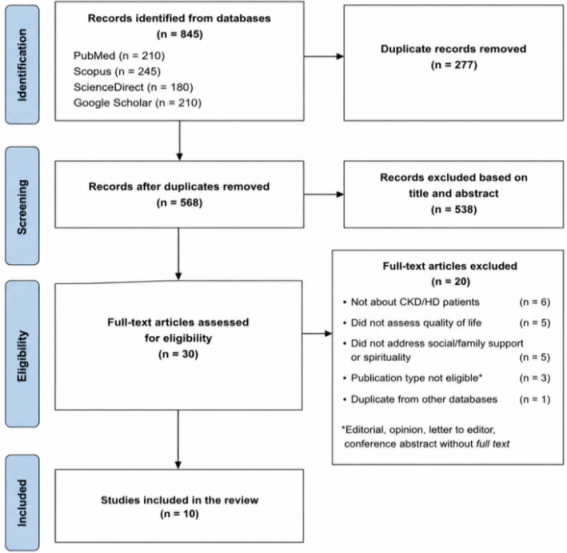
Background: Diabetes Mellitus (DM) patients undergoing hemodialysis often experience diminished quality of life (QoL) due to physical, psychological, and social challenges associated with chronic kidney disease. Social support and spirituality have been identified as key psychosocial factors that may influence patients’ well-being and treatment outcomes. Objective: This systematic review aims to evaluate the impact of social support and spirituality on the quality of life of DM patients undergoing hemodialysis, synthesizing evidence from recent studies conducted across diverse cultural and clinical settings. Methods: A comprehensive literature search was performed across PubMed, Scopus, ScienceDirect, and Google Scholar for studies published between 2015 and 2025. Inclusion criteria focused on studies reporting social support, family support, spiritual well-being, and QoL outcomes in hemodialysis patients, specifically those with DM or chronic kidney disease complications. Ten studies meeting eligibility criteria were analyzed, encompassing cross-sectional, descriptive-analytic, and quasi-experimental designs. Results: Across the studies, higher levels of social support, particularly from family and peers, were consistently associated with improved QoL. Spirituality, including religious engagement and personal spiritual well-being, further contributed to resilience, psychological stability, and enhanced coping with chronic treatment regimens. Combined interventions addressing both social support and spirituality demonstrated synergistic effects, leading to measurable improvements in physical, emotional, and social domains of QoL. Evidence from diverse regions, including Indonesia, Saudi Arabia, Iran, and Iraq, indicates the universal relevance of these factors. Conclusion: Social support and spirituality are pivotal determinants of QoL among DM patients undergoing hemodialysis. Integrating structured psychosocial and spiritual interventions into routine hemodialysis care may enhance patient outcomes and promote holistic management. Future research should investigate longitudinal effects and interventional strategies to optimize QoL in this population.
| Published in | American Journal of Health Research (Volume 14, Issue 3) |
| DOI | 10.11648/j.ajhr.20261403.15 |
| Page(s) | 172-178 |
| Creative Commons |
This is an Open Access article, distributed under the terms of the Creative Commons Attribution 4.0 International License (http://creativecommons.org/licenses/by/4.0/), which permits unrestricted use, distribution and reproduction in any medium or format, provided the original work is properly cited. |
| Copyright |
Copyright © The Author(s), 2026. Published by Science Publishing Group |
Social Support, Spirituality, Quality of Life, Diabetes Mellitus, Hemodialysis, Chronic Kidney Disease, Patient Well-being, Nursing Care
No. | Authors & Year | Study Design | Sample | Key Results |
|---|---|---|---|---|
1. | Wulandari, E. M., Yunita, R., & Hartono, D. (2023) | Cross-sectional correlational | 38 chronic kidney disease patients undergoing hemodialysis, RSUD dr. R. Soedarsono, Pasuruan, Indonesia | Social support levels were measured and correlated with quality of life (QoL). Most patients had high social support (42.1%) and moderate QoL (52.6%). Spearman’s rank correlation showed a significant positive relationship between social support and quality of life (p < 0.05), indicating that higher social support is associated with better QoL. Majority of participants were female (55.3%) and aged 36–45 years. |
2. | Wardani, A. D., Ratnawati, D., & Siregar, T. (2026) | Descriptive-analytic, cross-sectional | 61 elderly Diabetes Mellitus patients, Kelurahan Limo, Indonesia | Social support and spirituality were significantly associated with quality of life in elderly DM patients. Chi-square test showed social support (p = 0.048) and spirituality (p = 0.026) positively correlated with higher QoL. Elderly with higher social and spiritual support had better quality of life compared to those with lower support. |
3. | Irwan, M., Ginting, C. N., & Chiuman, L. (2025) | Cross-sectional quantitative | 100 Diabetes Mellitus patients undergoing hemodialysis, RSUD Arifin Achmad, Riau Province, Indonesia | Family support and spirituality were significantly associated with quality of life. Family support had a dominant influence (path coefficient 0.320, p < 0.05), especially emotional, instrumental, and informational support. Spirituality also contributed significantly (path coefficient 0.187, p < 0.05). Together, these factors explained 33% of the variance in patients' quality of life. |
4. | Agrivina, D., Nasution, B. R., Nasution, T. A., et al. (2026) | Cross-sectional analytical | 50 CKD patients undergoing regular hemodialysis, Adam Malik Hospital, Medan, Indonesia | Social support and spirituality were significantly positively associated with resilience. Majority of patients had high resilience (66%). High social support and spirituality enhanced patients’ coping and adaptation to hemodialysis therapy. Sociodemographic factors were not significant. |
5. | Rosyadi, A., Hapsari, I., & Utami, P. I. (2021) | Cross-sectional | 48 Diabetes Mellitus patients with CKD complications, Siaga Medika Purbalingga Hospital, Indonesia | Lifestyle, spirituality, and family support were significantly associated with quality of life (QoL). 62.5% of patients had good QoL. Patients with higher lifestyle and spirituality scores had 11 times higher chance of better QoL. Better family support also positively influenced QoL (OR 0.13). The study emphasizes counseling and psychosocial support to improve QoL in DM patients with CKD complications. |
6. | Hassani, F., Zarea, K., Gholamzadeh Jofreh, M., Dashtebozorgi, Z., & Chan, S. W. C. (2022) | Descriptive cross-sectional | 260 hemodialysis patients, three educational hospitals, Ahvaz, Iran | Perceived social support, spiritual well-being, resilience, and health literacy were significant predictors of quality of life (QOL). Structural Equation Modeling (SEM) showed that higher social support and spiritual well-being were associated with improved QOL. Resilience mediated the relationship between social support/spirituality and QOL. Demographics were not significant. |
7. | Al-Khaqani, M. A., & AL-Fayyadh, S. (2024) | Cross-sectional | 234 hemodialysis patients, University of Baghdad, Iraq | Social support and spiritual well-being significantly influenced quality of life (QOL). Regression analysis: social support t=1.434, p=0.038; spiritual well-being t=1.906, p=0.015; F (2,231)=3.14, p=0.034; R²=0.45. Higher social support and spirituality were associated with better QOL, although overall QOL remained moderate. |
8. | Wahyuni, M. M. D., Roga, A. U., Faida, E. W., Alkatiri, F. M., & Palandima, R. K. T. I. (2026) | Cross-sectional | 176 Indonesian Christian patients with End-Stage Renal Disease (ESRD) undergoing hemodialysis, Prof. Dr. W. Z. Johannes Hospital, Kupang, Indonesia | Spirituality and social support were positively associated with quality of life (QoL). Higher perceived social support (MSPSS) and higher spiritual experience (DSES) correlated with improved QoL (measured by WHOQOL). The study emphasizes culturally tailored interventions to enhance social and spiritual support to improve patient QoL. |
9. | Susanti, B. D. N., Setiawan, A. H., Ikwan, M., Umamah, F., Zahroh, C., et al. (2025) | Quasi-experimental, pre- and post-test control group | 92 CKD patients undergoing hemodialysis, Rumah Sakit Islam Surabaya, Indonesia | Spiritual social support significantly reduced depressive symptoms and improved quality of life (QoL) in CKD patients. The intervention group showed measurable improvements in QoL scores post-intervention compared to controls. This highlights the importance of spiritual and social support interventions to enhance psychological well-being and QoL in hemodialysis patients. |
10. | Asiri, W. A., Asiri, A. A. H., Almutlaq, A. H., Almutairi, K. H., Alotaibi, A. E., Alshahrani, M. S., & Hassan, E. E. A. (2023) | Cross-sectional | 162 haemodialysis patients, Aseer Region, Saudi Arabia | High perceived social support (79.6%) and high religiosity/spirituality were positively associated with quality of life (QOL). Longer duration of haemodialysis did not significantly affect QOL. The study emphasizes that enhancing social and spiritual support can improve psychological well-being and QOL in HD patients. |
CKD | Chronic Kidney Disease |
DM | Diabetes Mellitus |
ESRD | End-stage Renal Disease |
HD | Hemodialysis |
QoL | Quality of Life |
PSS | Perceived Social Support |
MSPSS | Multidimensional Scale of Perceived Social Suport |
DSES | Daily Spiritual Experiences Scale |
WHOQOL | World Health Organization Quality of Life Questionnaire |
PLS | Partial Least Squares |
SEM | Structural Equation Modeling |
| [1] | (International Diabetes Federation) IDF, “Diabetes Facts & Figures.” Available: |
| [2] | R. Jha, S. Lopez-Trevino, H. R. Kankanamalage, and J. C. Jha, “Diabetes and Renal Complications: An Overview on Pathophysiology, Biomarkers and Therapeutic Interventions,” Biomedicines, vol. 12, no. 5, pp. 1–23, 2024, |
| [3] | R. Shaw, S. K. Sadhukhan, J. Pal, P. Mukherjee, and A. Biswas, “Factors Influencing Quality of Life in Hemodialysis Patients With Chronic Kidney Disease at a Tertiary Care Hospital in Eastern India,” Cureus, vol. 17, no. 7, 2025, |
| [4] | L. Sułkowski, A. Matyja, and M. Matyja, “Social Support and Quality of Life in Hemodialysis Patients: A Comparative Study with Healthy Controls,” Med., vol. 60, no. 11, pp. 1–14, 2024, |
| [5] | D. Agrivina, B. R. Nasution, T. A. Nasution, R. Amalia, and C. Saragih, “The Relationship of Social Support and Spirituality to Resilience in Chronic Kidney Disease Patients Undergoing Regular Hemodialysis at Adam Malik Hospital Medan in 2025,” Indonesian Journal of Kidney and Hypertension. vol. 3, no. 1, pp. 162–168, 2026, |
| [6] | Y. Wang, Y. Qiu, L. Ren, H. Jiang, M. Chen, and C. Dong, “Social support, family resilience and psychological resilience among maintenance hemodialysis patients: a longitudinal study,” BMC Psychiatry, vol. 24, no. 1, pp. 1–13, 2024, |
| [7] | J. M. Pérez-Jiménez, P. Bonilla Sierra, and R. de-Diego-Cordero, “The Influence of Spirituality in the Care of Patients with Advanced Chronic Illnesses and at the End of Life: An Integrative Review,” J. Relig. Health, vol. 65, no. 1, pp. 451–479, 2026, |
| [8] | A. M. Bakhsh and W. H. Mahallawi, “Psychological Effects of Hemodialysis on Patients with Renal Failure: A Cross-Sectional Study,” J. Clin. Med., vol. 14, no. 20, pp. 1–8, 2025, |
| [9] | D. T. Bulathwatta, J. Borchet, A. Rudnik, and M. Bidzan, “Psychosocial well-being among individuals with chronic kidney disease undergoing hemodialysis treatment and their caregivers: a protocol of a mixed method study in Sri Lanka and Poland,” Front. Psychol., vol. 14, no. December, pp. 1–13, 2023, |
| [10] |
E. M. Wulandari, R. Yunita, and D. Hartono, “The Relationship between Social Support and Quality of Life of Renal Failure Patients Undergoing Hemodialysis at Dr. R. Soedarsono Regional Hospital, Pasuruan,” Mandira Cendikia Journal of Health Sciences, vol. 2, no. 10, pp. 440–448, 2023.
https://journal.mandiracendikia.com/index.php/JIK-MC/article/view/634 |
| [11] | A. D. Wardani et al., “Social Support and Spirituality in Relation to Quality of Life among Elderly Patients with Diabetes Mellitus Undergoing Hemodialysis,” Widya Gantari Indonesia Journal of Nursing, vol. 10, no. 1, 2026, |
| [12] | M. Irwan, C. N. Ginting, and L. Chiuman, “The Relationship between Family Support and Spirituality with Quality of Life of Diabetes Mellitus Patients Undergoing Hemodialysis at Arifin Achmad Regional Hospital, Riau Province,” Malahayati Health Student Journal., vol. 5, no. 8, pp. 3854–3870, 2025. |
| [13] | M. M. D. Wahyuni, A. U. Roga, E. W. Faida, M. A. Fahira, and R. K. T. I. Palandima, “Spirituality, Social Support, and Quality of Life: A Study of Indonesian Christian Patients With End-Stage Renal Undergoing Haemodialysis Treatment,” Journal of Health Information, vol. 24, no. 1, pp. 115-125., 2026, |
| [14] | A. Rosyadi, I. Hapsari, and P. I. Utami, “The Effect of Lifestyle, Spiritual, and Family Support on Diabetic Mellitus Patient with Chronic Kidney Disease Complication,” Pharm. J. Indones., vol. 18, no. 2, pp. 422–431, 2021. |
| [15] | Al-Khaqani, M. A. Yaseen, and S. AL-Fayyadh, “Effect of Social Support and Spiritual Well-being on the Quality of Life of Patients Undergoing Hemodialysis,” South East. Eur. J. Public Heal., vol. 24, no. 4, pp. 760–777, 2024, |
| [16] | W. A. Asiri et al., “Social support, religiosity, and quality of life among haemodialysis patients in Aseer region, Saudi Arabia,” Middle East Curr. Psychiatry, vol. 30, no. 1, 2023, |
| [17] | Susanti et al., “The Beneficial Effect of Spiritual Social Support on Depression and Quality of Life in Chronic Renal Failure Patients Undergoing Haemodialysis,” Scr. Medica (Banja Luka), vol. 56, no. 2, pp. 299–305, 2025, |
APA Style
Irwan, M. (2026). Social Support and Spirituality as Determinants of Quality of Life in Diabetes Mellitus Patients on Hemodialysis: A Systematic Review. American Journal of Health Research, 14(3), 172-178. https://doi.org/10.11648/j.ajhr.20261403.15
ACS Style
Irwan, M. Social Support and Spirituality as Determinants of Quality of Life in Diabetes Mellitus Patients on Hemodialysis: A Systematic Review. Am. J. Health Res. 2026, 14(3), 172-178. doi: 10.11648/j.ajhr.20261403.15
AMA Style
Irwan M. Social Support and Spirituality as Determinants of Quality of Life in Diabetes Mellitus Patients on Hemodialysis: A Systematic Review. Am J Health Res. 2026;14(3):172-178. doi: 10.11648/j.ajhr.20261403.15
@article{10.11648/j.ajhr.20261403.15,
  author = {Muhammad Irwan},
  title = {Social Support and Spirituality as Determinants of Quality of Life in Diabetes Mellitus Patients on Hemodialysis:
A Systematic Review},
  journal = {American Journal of Health Research},
  volume = {14},
  number = {3},
  pages = {172-178},
  doi = {10.11648/j.ajhr.20261403.15},
  url = {https://doi.org/10.11648/j.ajhr.20261403.15},
  eprint = {https://article.sciencepublishinggroup.com/pdf/10.11648.j.ajhr.20261403.15},
  abstract = {Background: Diabetes Mellitus (DM) patients undergoing hemodialysis often experience diminished quality of life (QoL) due to physical, psychological, and social challenges associated with chronic kidney disease. Social support and spirituality have been identified as key psychosocial factors that may influence patients’ well-being and treatment outcomes. Objective: This systematic review aims to evaluate the impact of social support and spirituality on the quality of life of DM patients undergoing hemodialysis, synthesizing evidence from recent studies conducted across diverse cultural and clinical settings. Methods: A comprehensive literature search was performed across PubMed, Scopus, ScienceDirect, and Google Scholar for studies published between 2015 and 2025. Inclusion criteria focused on studies reporting social support, family support, spiritual well-being, and QoL outcomes in hemodialysis patients, specifically those with DM or chronic kidney disease complications. Ten studies meeting eligibility criteria were analyzed, encompassing cross-sectional, descriptive-analytic, and quasi-experimental designs. Results: Across the studies, higher levels of social support, particularly from family and peers, were consistently associated with improved QoL. Spirituality, including religious engagement and personal spiritual well-being, further contributed to resilience, psychological stability, and enhanced coping with chronic treatment regimens. Combined interventions addressing both social support and spirituality demonstrated synergistic effects, leading to measurable improvements in physical, emotional, and social domains of QoL. Evidence from diverse regions, including Indonesia, Saudi Arabia, Iran, and Iraq, indicates the universal relevance of these factors. Conclusion: Social support and spirituality are pivotal determinants of QoL among DM patients undergoing hemodialysis. Integrating structured psychosocial and spiritual interventions into routine hemodialysis care may enhance patient outcomes and promote holistic management. Future research should investigate longitudinal effects and interventional strategies to optimize QoL in this population.},
 year = {2026}
}
TY  - JOUR
T1  - Social Support and Spirituality as Determinants of Quality of Life in Diabetes Mellitus Patients on Hemodialysis:
A Systematic Review
AU  - Muhammad Irwan
Y1  - 2026/06/29
PY  - 2026
N1  - https://doi.org/10.11648/j.ajhr.20261403.15
DO  - 10.11648/j.ajhr.20261403.15
T2  - American Journal of Health Research
JF  - American Journal of Health Research
JO  - American Journal of Health Research
SP  - 172
EP  - 178
PB  - Science Publishing Group
SN  - 2330-8796
UR  - https://doi.org/10.11648/j.ajhr.20261403.15
AB  - Background: Diabetes Mellitus (DM) patients undergoing hemodialysis often experience diminished quality of life (QoL) due to physical, psychological, and social challenges associated with chronic kidney disease. Social support and spirituality have been identified as key psychosocial factors that may influence patients’ well-being and treatment outcomes. Objective: This systematic review aims to evaluate the impact of social support and spirituality on the quality of life of DM patients undergoing hemodialysis, synthesizing evidence from recent studies conducted across diverse cultural and clinical settings. Methods: A comprehensive literature search was performed across PubMed, Scopus, ScienceDirect, and Google Scholar for studies published between 2015 and 2025. Inclusion criteria focused on studies reporting social support, family support, spiritual well-being, and QoL outcomes in hemodialysis patients, specifically those with DM or chronic kidney disease complications. Ten studies meeting eligibility criteria were analyzed, encompassing cross-sectional, descriptive-analytic, and quasi-experimental designs. Results: Across the studies, higher levels of social support, particularly from family and peers, were consistently associated with improved QoL. Spirituality, including religious engagement and personal spiritual well-being, further contributed to resilience, psychological stability, and enhanced coping with chronic treatment regimens. Combined interventions addressing both social support and spirituality demonstrated synergistic effects, leading to measurable improvements in physical, emotional, and social domains of QoL. Evidence from diverse regions, including Indonesia, Saudi Arabia, Iran, and Iraq, indicates the universal relevance of these factors. Conclusion: Social support and spirituality are pivotal determinants of QoL among DM patients undergoing hemodialysis. Integrating structured psychosocial and spiritual interventions into routine hemodialysis care may enhance patient outcomes and promote holistic management. Future research should investigate longitudinal effects and interventional strategies to optimize QoL in this population.
VL  - 14
IS  - 3
ER  -
Department of Nursing, STIKES Tengku Maharatu, Pekanbaru, Indonesia
Biography: Muhammad Irwan, was born on February 9, 1986, in Suka Damai Village, Singingi Hilir Subdistrict, Kuantan Singingi Regency, Riau Province, Indonesia. He completed his Bachelor of Nursing (S. Kep.) at STIKes Tengku Maharatu in 2011 and the Nursing Profession Program (Ns.) in 2012 at the same institution. He earned his Master of Nursing (M. Kep.) from Universitas Padjadjaran in 2019 and completed his Doctorate in Medical Science at Universitas Prima Indonesia in 2026. Dr. Irwan has been a full-time lecturer in the Nursing Science Study Program at STIKes Tengku Maharatu, Pekanbaru, since 2012. He is active in academic research, national and international conferences, professional training, and seminars, particularly focusing on nursing management for Diabetes Mellitus patients and hemodialysis therapy. He has contributed as a speaker, resource person, and research contributor in multiple scholarly forums.
Research Fields: Medical-Surgical Nursing; Chronic Disease Nursing; Renal-Endocrine Nursing; Hemodialysis Care; Diabetes Mellitus Management; Chronic Kidney Disease Management; Social Support; Spirituality; Quality of Life.


Information



 Share This Article
 Twitter
 Linked In
 Facebook
 Copy
Copy Download